 ACT Playbook
How We Work: The Toolkit
AI-Supported Sales & Marketing
Everyone talks about AI taking over sales, and it is only ever as good as the context you give it. "Write me an outreach email" is a useless prompt when the model knows nothing about your product, the persona you are targeting, or your competition.
Setup only takes about an hour. The time savings in your next campaign are big.
Why It Matters
AI grounded in your company’s product context
An agent is only as good as the context it can read: the value your product creates, who you sell to, how your customers name the problem, skills that codify how your team already works, and one place where your team works together.
One source of truth, read while the agent works
The MCP server serves your live value architecture into the agent. Change a value driver in the platform, and the next email, page, and battle card already use it.
Skills that hand off to each other
Competitive analysis based on your value drivers, a website audit that feeds website SEO briefs and finished pages, call preparations grounded in the full context.
It runs in the agent you already pay for
Claude Code, Codex, or Claude Cowork, in the editor or the chat window your team already has open. You do not buy another seat or teach anyone another interface.
Output your team can read and correct
A centralized shared respository your whole team can work in. No more sharing of messaging documents, whitepaper drafts, or social media postings via email.
How It Runs
Context in, work product out, in the tool you already use
Your context
- Value architecture, served live by the MCP server
- Positioning and messaging
- Competitive research
- Sales campaigns, social media posts, and any other content ever created
Your agent and the skills
- Your favorite harness: ChatGPT, Claude Code, Codex, or Claude Cowork
- Skills that build on each other and work together
- Every prompt uses the same context to sharpen the output
Your repository
- Files written where your team expects them
- Every claim sourced, every gap flagged
- Nothing published or committed without you
What your team reviews and keeps becomes the context the next run reads, so the system gets more accurate the more you use it.
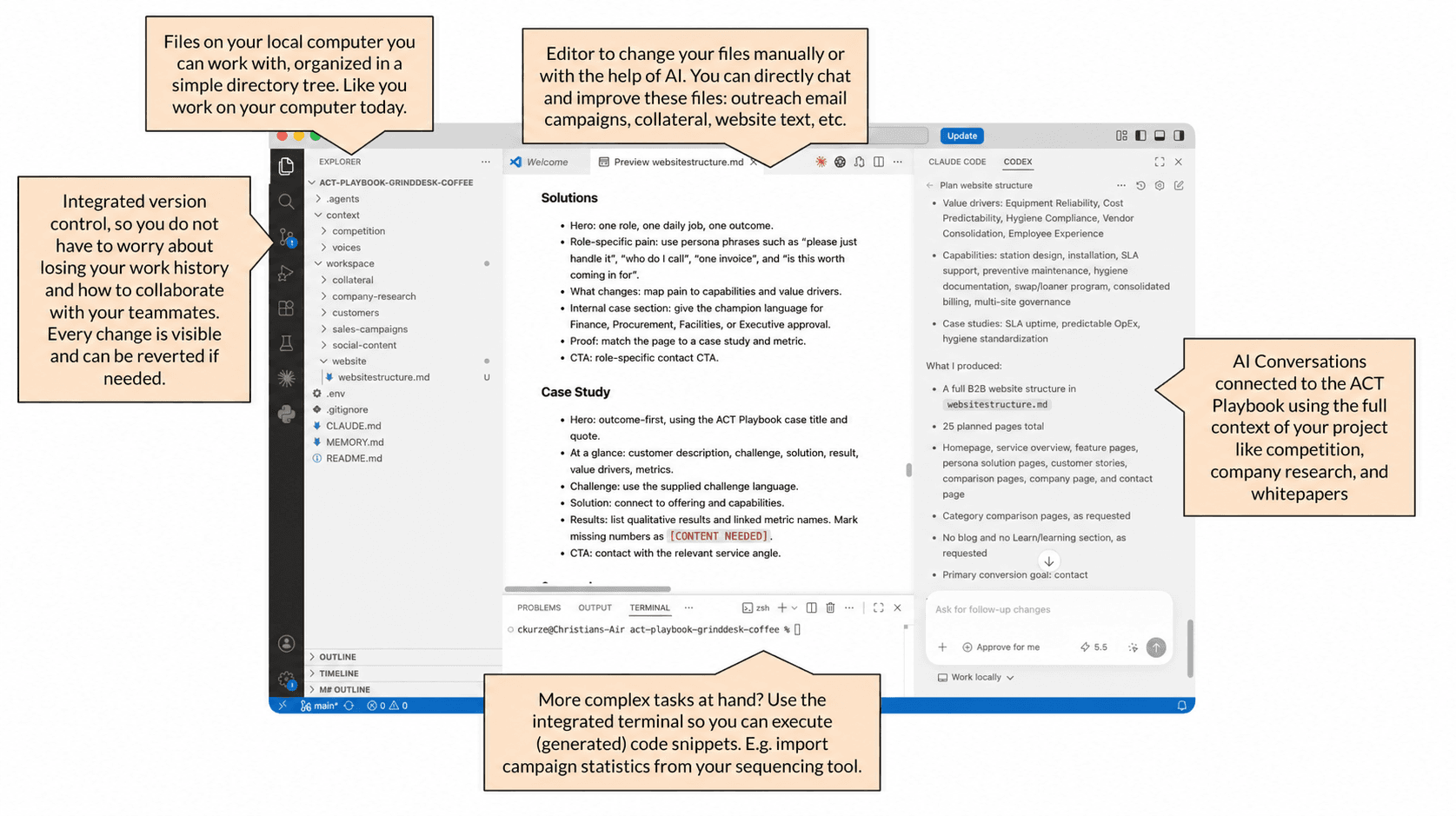
Your workspace is Visual Studio Code
One private repository from our template, cloned to your own computer, holds your company knowledge in a plain directory tree. The same window gives you the editor where you and the agent change files, version control that keeps every change reversible and visible to your team, the agent panel connected to your ACT Playbook context, and a terminal for the rare task that needs one. Nobody needs technical expertise or a second set of applications to work in it.
Your agent connects to both sides
One command installs the skill pack, and an OAuth sign-in connects the ACT Playbook MCP server to the organization you authorize. The repository gives the agent your context, and the MCP server gives it your value architecture as it stands today.
From there you call a skill by name. It asks its setup questions, runs on its own, and reports which files it wrote and what it could not verify.
Works with
- Claude Code, in VS Code, JetBrains, or the terminal
- Codex, in the IDE extension or the CLI
- Claude Cowork and Claude on the web or desktop
- Any other agent that speaks MCP and reads skills
Beyond The Skills
The same grounding works in plain conversation
The daily work gets reduced to simple prompts that automatically use the available context.
- Research this account [URL] before my first call and identify the decision makers. Use our customer profiles and value drivers from ACT Playbook MCP, and tell me which persona I am most likely talking to.
- Draft the follow-up to yesterday’s discovery call. Use the metrics this persona cares about and the objections we captured. Update the deal in the CRM system with learning. Give me hints where I have blind spots that I need to close in the next conversation.
- Write a LinkedIn post about the problem our second value driver solves. Company voice, no product pitch in the first three lines.
- Prepare the demo workshop for this account. Which key capabilities should I lock in as decision criteria, and what proof do we have for each?
Every person in the company uses the same value-oriented language, speeding up ramping, and every day-to-day task, to updating the deal qualification in the CRM system.
Your commitment
An hour of setup, and a value architecture worth grounding on
About an hour, once. Roughly 50 minutes of setup plus a buffer for browser sign-ins and any approval your company device needs. You need a GitHub account, one agent account, and permission to install applications.
A value architecture, or the willingness to build one first. Every skill reads from it, so this is the step that decides whether the output is specific or generic.
Someone who reviews the first run of each skill. The agent marks what it could not verify as a gap rather than filling it, and a person has to close those gaps.
A private repository and discipline with secrets. The repo holds customer information, pricing, and strategy, so we walk you through how to handle keys and not sharing confidential information by accident.
We set this up with you in the Hands-On Implementation, and the Self-Paced Implementation walks you through the same steps on your own schedule.
How We Work Together
Included in every way we work together
Every engagement includes the platform, MCP access, the repository template, and the skills. The sprint and its report run the same way for everyone, and you decide who executes the plan.
Report and Action Plan
Every finding in one report, sorted into now, next, and later, each item with an owner and a measure for progress.
Then you choose
Hands-On Implementation
We run the plan with you in two-week sprints, coaching where your team leads and executing where capacity is missing.
See how it works →Self-Paced Implementation
You run the plan with your team or a partner, at your own pace, with the frameworks and templates.
See how it works →See it running on your own value architecture
Bring your current setup to a 30-minute call. We connect the pieces to a real example from your business, and you see what the output looks like before you decide anything.