 ACT Playbook
How We Work: The Toolkit
Sales Execution Templates
Build your sales process that strictly follows how your customers buy and how you help them to understand and articulate their problems, make your solution the best fit and win the deal from the technical and commercial perspective.
Why It Matters
Deals stall in the gaps between meetings
Every meeting needs a next step in the calendar, and the value you deliver in it has to bring your prospect closer to a decision. Discovery has to surface the real pain. Many demos are a feature walkthrough, when their job is to identify and influence the decision criteria, and a proof of concept is not jsut for the technical win, it has to prove the commercial viability of your solution. These templates are battle-proven by the top 5% of B2B sales organizations. Make them your own.
The process is written down
Your stages, the exit criteria for each one, and the activities that carry a deal between them live in a document your team can follow. A deal stops depending on who happens to run it.
Every milestone has an asset
Discovery, demo, business case, and proposal each come with a template where the structure already exists. Your preparation time goes into the customer specifics.
Deals become comparable
When every deal runs through the same qualification and the same artifacts, a pipeline review becomes a discussion about evidence. Optimism stops counting as pipeline.
Build The Foundation
Sales process and deal qualification
You need to think form the buyer’s perspective first, before individual assets make sense: the process how your solution gets bought, and the qualification that tells you whether there is a real deal and what is missing.
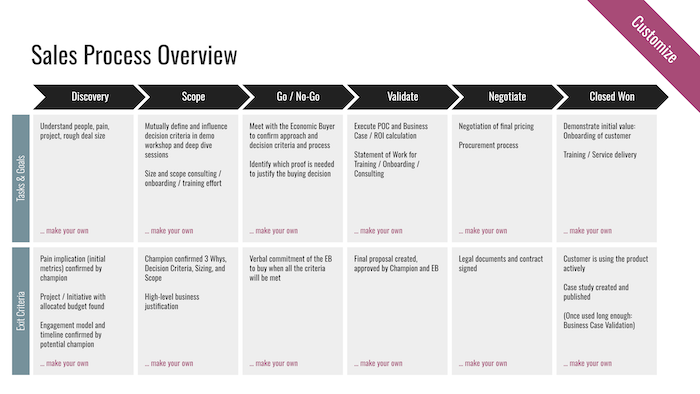
Sales Process Overview
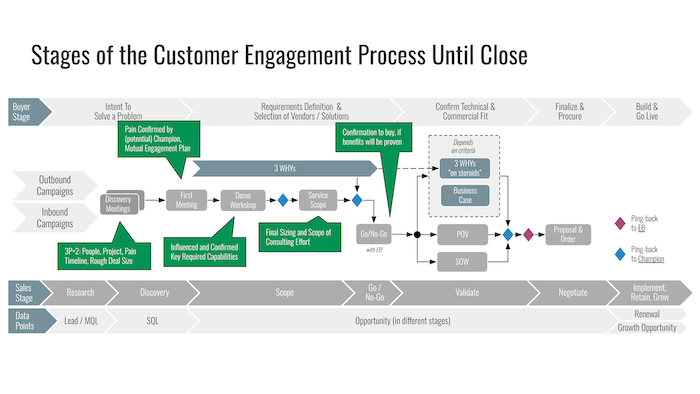
The buying process mapped to the activities that move a deal forward, with a defined entry and exit for every stage. Your team gets one picture of what happens when. Without it, every rep runs a private version of the process.
Sales Process Development Kit
A working kit to select the sales motion that matches your average contract value and deal complexity, from high-velocity self-serve to a guided, human-led process. You end up with written stages, exit criteria, and the activities your team runs in each one.
Deal Qualification
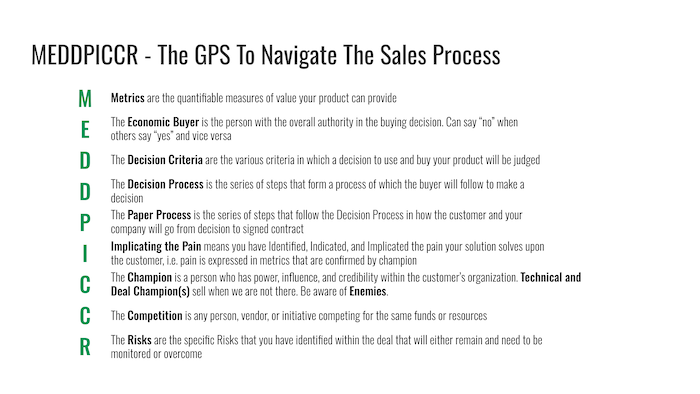
MEDDPICCR as the GPS that runs alongside your sales process. All nine dimensions are explained with the questions that fill them, so you can see what is missing in a deal while there is still time to fix it.
Deal Qualification Kit
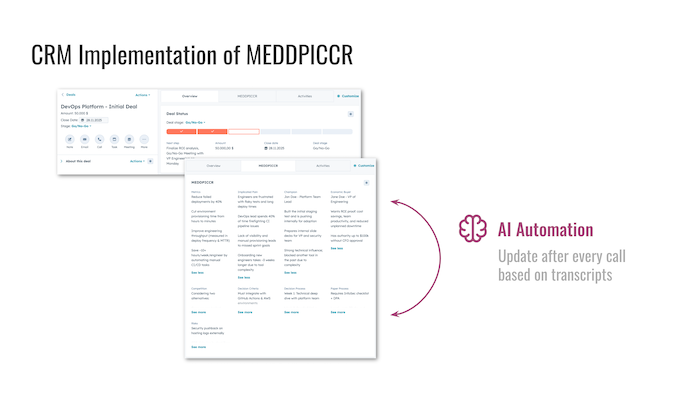
The nine dimensions as fields you configure directly in your CRM, plus AI automation that updates the record after every call. Qualification then survives a busy week and is not just admin work anymore.
Prepare Your Assets
One template for every milestone in the deal
12 assets that follow the deal from the first discovery call to the signature. Each one comes as a slide or document template with the structure in place, plus the guidance on when to use it and what has to be true before you move on.
3 Whys
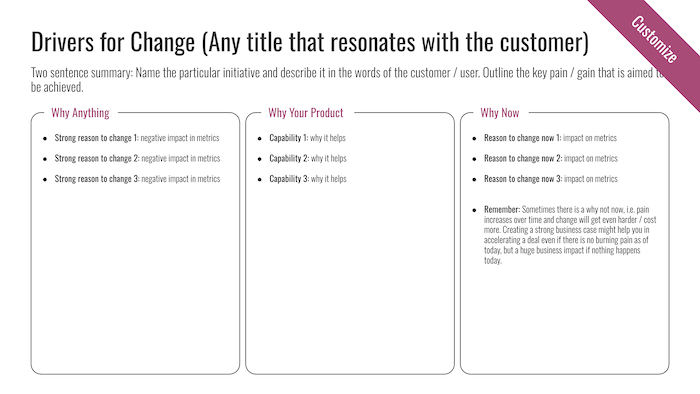
Why act, why you, and why now, written in language your champion can carry into the room with the economic buyer. If your champion cannot answer those three questions without you, the deal stalls at the budget conversation.
Discovery Call
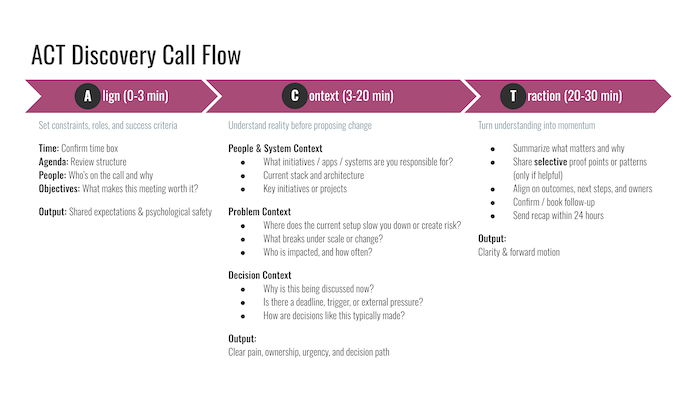
A structure for preparing, running, and debriefing discovery: what you need to walk away with, and the mistakes that you pay for two months later when the deal suddenly stalls.
Discovery Cheat Sheet
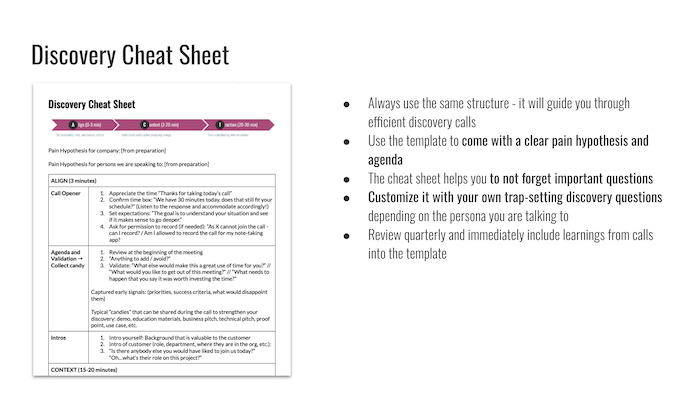
One page you can bring into every call, with the questions in the right order, space to capture what you hear, and objection handling grounded in your own product. Everyone runs the same discovery, which makes it comparable across deals.
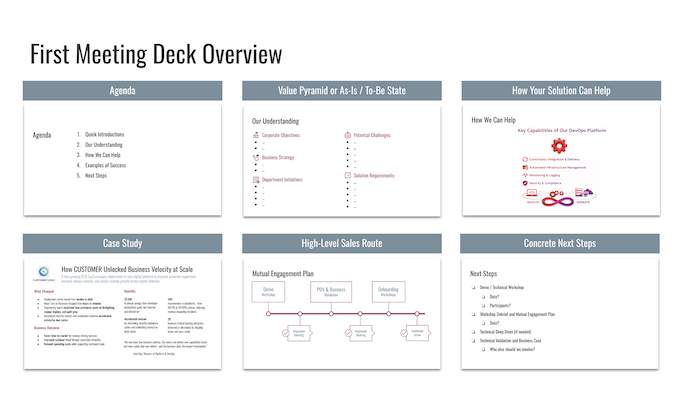
First Meeting
The most important meeting to validate pain and agree on a mutual plan to work on evaluation until close of the deal. The plan automatically gives you a next step you can book with your champion.
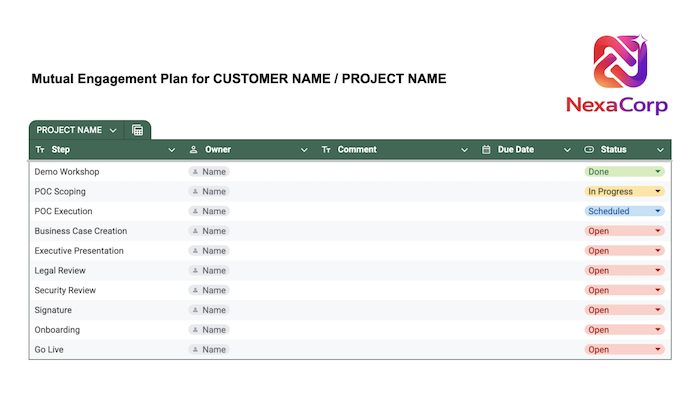
Mutual Engagement Plan
A shared plan with dates, owners, and milestones from shaping decision criteria to signature. Urgency then comes from a plan you both agreed to, so you stop chasing for status updates.
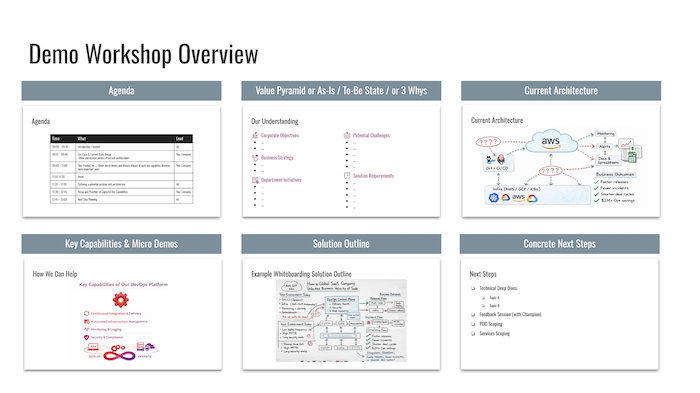
Demo Workshop
A demo format that surfaces pain, locks in the key capabilities that matter to the evaluation, and builds consensus across stakeholders. Run well, it shapes the decision criteria and traps out your competition before the formal evaluation starts.
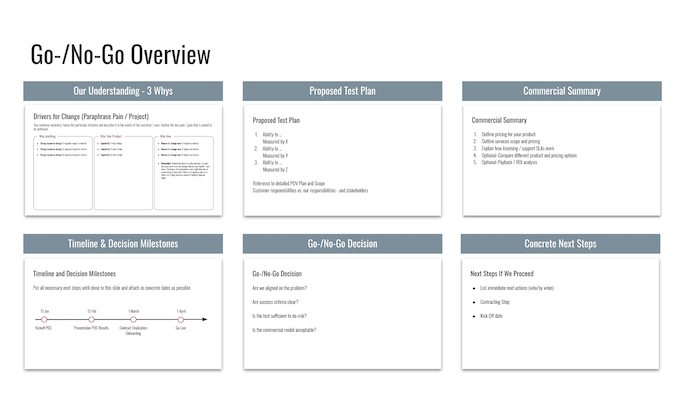
Go-/No-Go Meeting
The gate in front of a technical evaluation, with a short agenda to get an explicit go-ahead from the economic buyer. Many sales processes skip this step and spend weeks proving technical fit to a project that was never funded or important evaluation criteria have been missing.
Business Case
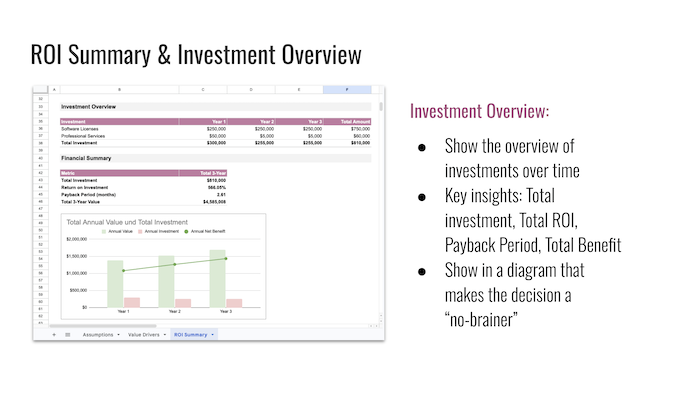
The financial argument for why the cost of change is lower than the cost of staying put, quantified with the customer’s own numbers and grounded in your value architecture. It gives the executive who signs a clear perspective on investment, created value, ROI, and payback period.
Proof of Value / Proof of Concept
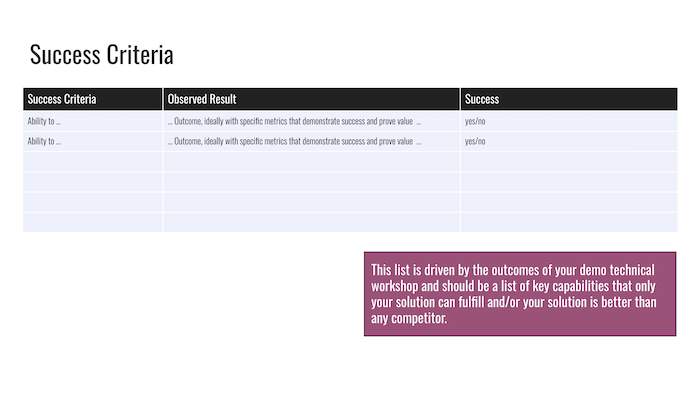
A test plan with success criteria agreed upfront, a scope that stays fixed while the evaluation runs, and a results format that moves you to the close. Without fixed criteria, a proof of concept restarts the conversation every time a new stakeholder joins.
Economic Buyer Ping-Back
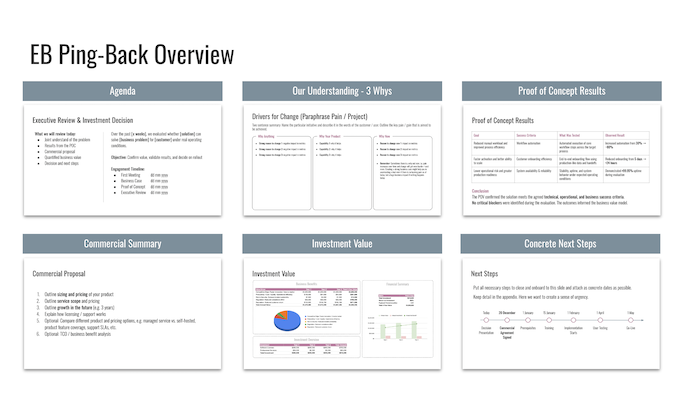
The executive review once the business case and the proof of concept are done. You present the results, confirm the commercial structure, and get agreement to move to a formal proposal.
Proposal
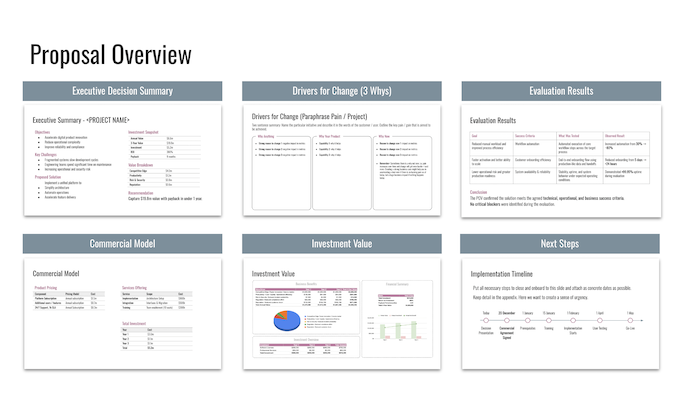
A proposal structure that captures everything already agreed through the process. Done properly, it reads as the conclusion of the evaluation. A proposal that surprises the buyer triggers a new round of questions.
Case Studies
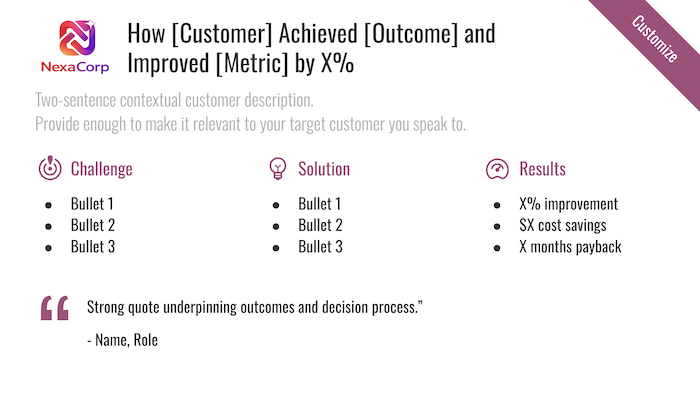
One customer story in the formats a deal actually needs: a one-pager, a slide, and a verbal reference your team can deliver from memory. A single solid story gets deployed across the whole cycle.
How You Get Them
Included in every way of working with us
The templates are a material part of all engagement models and need adoption to your product, your value architecture, and your buyer’s decision process. Blank files help nobody.
See the templates against your own deals
Bring one open deal to a 30-minute call. We look at the last stage it went through and which template would have changed the outcome, then we both decide whether this is worth doing.